Welcome! This manual guides you through setup and operation of your new GE Universal Remote, ensuring a seamless experience with all your devices.
What’s Included in the Box
Unboxing your GE Universal Remote reveals several key components designed for immediate use and long-term functionality. You should find the GE Universal Remote itself, carefully packaged to prevent damage during shipping. Alongside the remote, a comprehensive user manual – this very document – is included, providing step-by-step instructions for setup, programming, and troubleshooting.
Furthermore, the box contains a battery compartment cover, ensuring secure battery installation. Please note that batteries are not typically included; you will need to provide two AAA or AA batteries (depending on the model – check the remote’s base). Finally, a quick start guide offers a condensed version of the setup process for those eager to begin immediately. Verify all components are present before proceeding.
Remote Features Overview
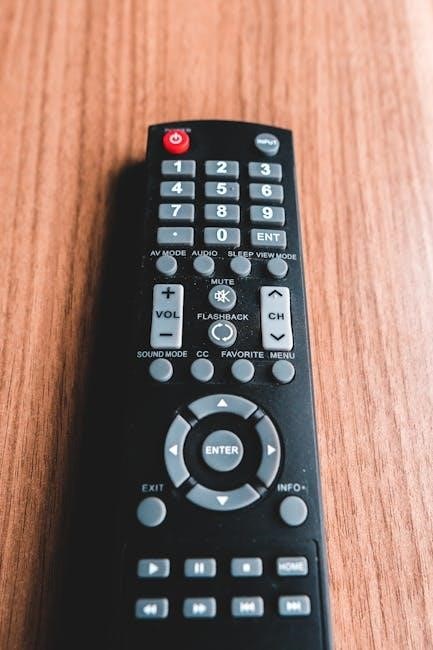
Your GE Universal Remote boasts a wide array of features designed for convenience and compatibility. It’s engineered to control televisions, DVD players, Blu-ray players, cable boxes, and auxiliary devices – consolidating multiple remotes into one. Key features include dedicated power, volume, and channel controls, alongside a numerical keypad for direct input.
The remote supports both automatic code search and manual code entry for programming, offering flexibility in setup. Macro programming allows you to combine multiple commands into a single button press, streamlining complex operations. A learning function enables the remote to mimic signals from existing remotes, expanding its compatibility. Explore these features to unlock the full potential of your entertainment system!
Initial Setup & Battery Installation
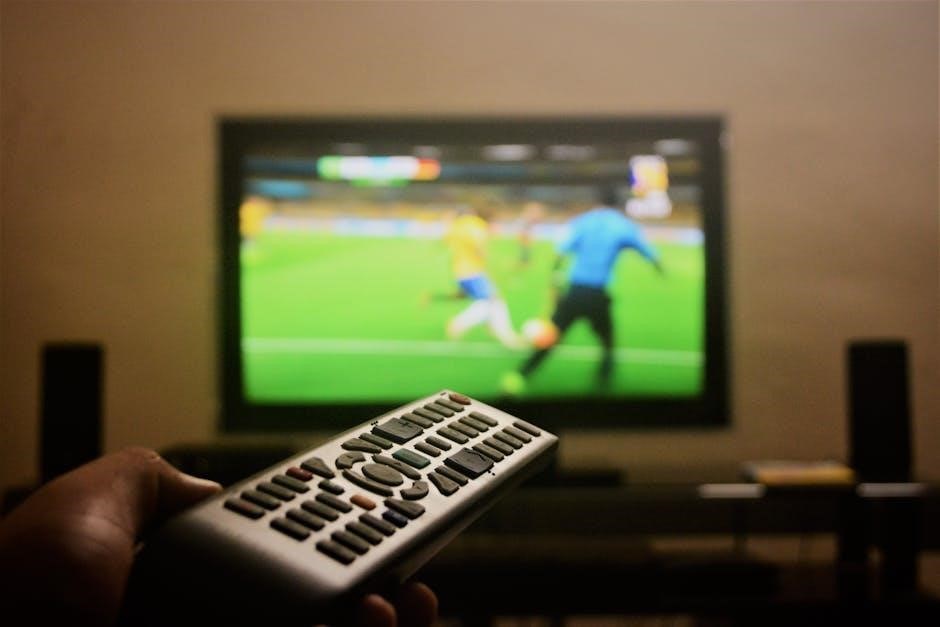
Begin by preparing your remote for use! This section details the simple steps for correctly installing batteries and powering on your new GE Universal Remote.
Installing Batteries Correctly
To begin, locate the battery compartment on the back of your GE Universal Remote. Gently slide the compartment cover open, typically by pressing a tab or sliding it downwards. Insert the required batteries – usually two AAA or AA size, as indicated by the diagram inside the compartment – ensuring correct polarity.
Pay close attention to the “+” and “-” symbols etched within the compartment, matching them to the corresponding ends of the batteries. Incorrect battery installation will prevent the remote from functioning. Once the batteries are securely in place, carefully slide the compartment cover back on until it clicks shut. A properly secured cover ensures the batteries remain stable during use and prevents accidental dislodgement.
Always use fresh batteries for optimal performance and avoid mixing old and new batteries.
Powering On the Remote
Unlike some remotes, the GE Universal Remote typically doesn’t have a dedicated “power on” button. It activates automatically when a button is pressed, assuming correctly installed batteries. After installing the batteries as described previously, simply press any button on the remote – for example, the power button, volume control, or channel selection.
If the remote doesn’t respond, double-check the battery installation, ensuring correct polarity and that the compartment cover is securely closed. A small indicator light may illuminate briefly when a button is pressed, confirming the remote is receiving power. If no light appears, the batteries are likely the issue.
Ensure there are no obstructions between the remote and the device you are trying to control.
Programming the GE Universal Remote
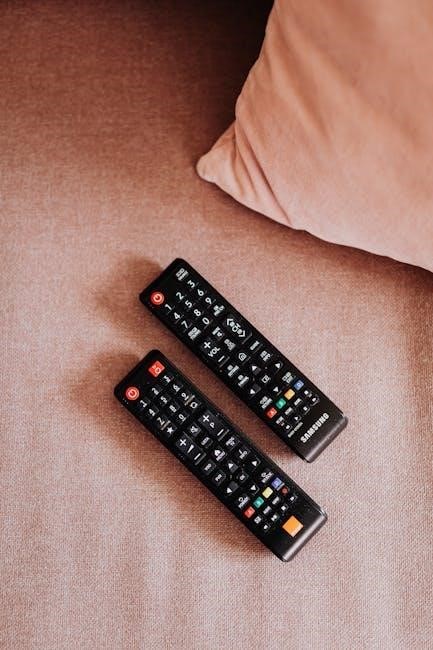
Let’s begin! Programming allows your GE remote to control various devices; utilize either the automatic code search or manual code entry methods detailed below.

Automatic Code Search Method
Initiating the Search: The automatic code search is a convenient way to program your GE Universal Remote without knowing your device’s specific code. First, power on the device you wish to control. Then, press and hold the ‘Setup’ button on the remote until the indicator light illuminates. Next, press the ‘Device’ button corresponding to the type of device (TV, DVD, etc.).
Code Cycling: The remote will now begin cycling through pre-programmed codes. The device should respond by turning off or changing the volume. If it responds, immediately press the ‘OK’ or ‘Enter’ button to lock in the code. If the device doesn’t respond within 30 seconds, the remote will automatically move to the next code. Repeat this process until you find a code that works. Be patient, as this method can take several minutes to complete!
Successful Programming: Once a working code is found, the indicator light will typically blink or turn off, confirming successful programming.
Manual Code Entry Method

Accessing the Code List: For a more direct approach, utilize the manual code entry method. Begin by powering on the device you intend to control. Then, press and hold the ‘Setup’ button on your GE Universal Remote until the indicator light activates. Subsequently, press the ‘Device’ button that corresponds to your device type – for example, ‘TV’ or ‘DVD’.
Entering the Code: The indicator light will illuminate, signaling you to enter the four or five-digit code found in the code list (refer to the included booklet or online resources). Carefully input each digit using the number buttons on the remote.
Code Confirmation: After entering the code, the indicator light should blink or turn off, confirming successful entry. Test the remote by attempting a function, such as increasing the volume or changing the channel. If it doesn’t work, repeat the process with a different code from the list.
Using the Code List
Locating Your Code: The GE Universal Remote code list is your key to successful programming. It’s typically included as a separate booklet with your remote, or available for download online; The list is organized by brand; locate your device’s manufacturer within the index.
Understanding Code Variations: You’ll often find multiple codes listed for each brand. This is because different models may respond to different codes. Start with the first code provided for your brand and proceed sequentially if the initial attempt fails.
Code Format: Codes are generally four or five-digit numbers. Ensure you enter each digit accurately when prompted by the remote’s programming sequence. Double-check your entries to avoid errors. Remember to consult the remote’s instruction manual for specific code entry procedures.
Troubleshooting Common Issues
Facing problems? This section offers solutions for typical issues like unresponsive remotes, incorrect codes, or devices that aren’t recognized by the GE remote.
Remote Not Responding
Is your GE Universal Remote failing to power on your devices? First, ensure fresh batteries are correctly installed, observing proper polarity. Confirm the batteries haven’t corroded, as this can disrupt the connection. Next, try resetting the remote by removing the batteries for one minute, then reinserting them.
Check for obstructions between the remote and your device’s infrared (IR) sensor. Ensure nothing is blocking the signal path. If the issue persists, attempt a different code from the code list, as the initially programmed code might be incompatible. Finally, verify the remote isn’t accidentally in a locked mode or a programmed function is overriding basic operation. A full factory reset might be necessary as a last resort.
Incorrect Code Entered
Experiencing issues where your GE Universal Remote isn’t controlling the correct functions? You likely entered an incorrect code during programming. Don’t worry, this is a common occurrence! Begin by revisiting the code list for your specific device brand and model. Double-check each digit entered, ensuring accuracy.
If you’re using the automatic code search, allow the remote to cycle through all available codes – it can take time. If the automatic search fails, revert to manual code entry. Try several codes listed for your device, as manufacturers sometimes use multiple codes. Remember to test basic functions like power and volume after each code attempt. A faulty code list or an outdated code can also be the culprit, so consider checking for updated lists online.
Device Not Recognized
Is your GE Universal Remote failing to recognize your television, DVD player, or other device? This often happens when the remote lacks the correct programming for that specific model. First, confirm your device is powered on and functioning independently. Then, meticulously review the device code list, ensuring you’ve selected the code corresponding to the exact manufacturer and model number.
If the listed code doesn’t work, explore alternative codes for the same brand. Some devices require a different code than expected. If your device is newer or less common, it might not be included in the standard code list; consider the learning function (if available) to teach the remote. Finally, ensure there are no obstructions between the remote and the device’s IR sensor.
Advanced Features & Settings
Unlock full potential! Explore macro programming for customized commands and the learning function to copy signals from original remotes for enhanced control.
Macro Programming
Automate your entertainment! Macro programming allows you to combine multiple remote commands into a single button press, simplifying complex operations. To begin, enter macro setup mode – consult your remote’s button layout for the dedicated macro key. You’ll then be prompted to input the sequence of commands you wish to record.
Carefully enter each command, pausing briefly between each one to ensure accurate recording. The remote will store these commands in a specific macro slot. Once the sequence is complete, save the macro to a desired button. Now, a single press of that button will execute the entire programmed sequence. Experiment with different command combinations to create personalized macros for your viewing pleasure. Remember to test your macros thoroughly to confirm they function as intended!
Learning Functionality
Expand your remote’s capabilities! The learning function enables your GE Universal Remote to mimic commands from other remotes, even those not listed in the code list. Initiate learning mode – typically accessed through a dedicated “Learn” button. The remote will then enter a receptive state, ready to capture signals.
Point the original remote at your GE remote and transmit the command you wish to learn. Ensure a close proximity and a clear line of sight. The GE remote will attempt to decode and store the signal. Repeat this process for each desired command. Successful learning is usually indicated by a confirmation signal. This feature is invaluable for devices with uncommon or proprietary remote protocols, offering unparalleled control and customization.
GE Online & Remote Compatibility (Regarding GE Online Game)
Gaming integration! Explore potential remote usage within GE Online (R), though compatibility and specific functions may vary; check forums for updates.
Remote Usage in GE Online ( R)
Enhanced Gameplay Potential: While not officially supported, some GE Online (R) players have explored utilizing the GE Universal Remote for specific in-game actions. This often involves macro programming, assigning frequently used key combinations to remote buttons for quicker access during combat or navigation.
Community-Driven Solutions: Due to the lack of direct integration, successful implementation relies heavily on community-shared configurations and tutorials. Players on platforms like the GE Online (R) (Bahamut) frequently discuss and share their custom remote setups.
Considerations & Limitations: Be aware that compatibility can be inconsistent, and functionality may be affected by game updates. Furthermore, using third-party modifications carries inherent risks, so proceed with caution and always back up your game data. Experimentation and careful configuration are key to maximizing the remote’s potential within GE Online (R).
Troubleshooting GE Online Specific Issues
Input Lag & Responsiveness: If experiencing delays between remote button presses and in-game actions within GE Online (R), verify the remote’s battery level and ensure a clear line of sight to your PC. Interference from other wireless devices can also contribute to lag.
Macro Conflicts: Incorrectly programmed macros may trigger unintended actions or conflict with the game’s native controls. Carefully review and adjust your macro settings, testing each one individually to identify and resolve conflicts. Refer to community forums for shared macro configurations.
Game Update Incompatibilities: GE Online (R) updates can sometimes disrupt remote functionality. If issues arise after an update, check community discussions for potential fixes or adjustments to your remote’s programming. Re-mapping controls may be necessary.